E8 Oled Review: Real User Experience After 3 Months
The Journey to the Perfect Display
I remember the day I finally decided to pull the trigger on the E8 OLED. My living room had been occupied by a mid-range LED panel for nearly five years, and while it served its purpose for evening news and the occasional sitcom, I felt like I was missing out on the cinematic revolution. I had spent weeks lurking in home theater forums, comparing subpixel layouts and agonizing over peak brightness nits. When the delivery truck finally arrived at my door with the E8, I felt that familiar rush of excitement mixed with a tiny bit of "buyer's remorse" anxiety—had I really spent this much on a piece of glass? Now that three months have passed, and the honeymoon phase has transitioned into the "daily driver" phase, I have a much clearer picture of what it is like to live with this television in a real-world environment.
My setup isn't a lab. I don't have colorimeters or specialized software to measure 100% recalibration accuracy. What I do have is a south-facing living room with moderate light control, a fluctuating collection of 4K Blu-rays, a very demanding gaming habit, and a wife who hates "soap opera effect" as much as I do. Over the last ninety days, I've pushed this set through everything from high-noon football games to midnight horror movie marathons. In my experience, the E8 is a fascinating piece of technology that offers some of the highest highs I've ever seen in a display, alongside a few specific quirks that only become apparent once you've stopped looking at the spec sheet and started actually watching the screen.
The Aesthetic Impact: Living with the "Picture on Glass"
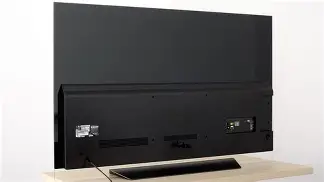
Before I even turned it on, the first thing I noticed was how much the E8 changed the room's energy. The "Picture on Glass" design isn't just marketing fluff; it actually makes the TV look like it's floating. The OLED panel is bonded directly to a glass back, and the bottom section extends into a transparent stand. In my living room, this helped the TV feel less like a giant black plastic void when turned off and more like a piece of modern furniture. However, I learned quickly that this beauty comes with a practical price: cable management. Because the bottom of the set is transparent, I found it much harder to hide the mess of HDMI cables and power cords behind the unit. I spent a good two hours with zip ties trying to ensure that the "floating" illusion wasn't ruined by a stray braided cable peeking through the glass base.
One thing that bothered me during the first week was the reflection. While the glass looks premium, it acts as a bit of a mirror when the TV is off or showing very dark scenes during the day. I noticed that if my floor lamp was positioned even slightly to the left, I could see a perfect reflection of the bulb during the cavern scenes in The Batman. I ended up having to rearrange my seating and lighting slightly to accommodate the E8’s glossy nature. It’s a trade-off I’m willing to make for the contrast, but if you have a room with floor-to-ceiling windows and no curtains, you’re going to spend a lot of time looking at yourself instead of the movie.
Picture Quality: The Absolute Black Obsession
I’ve been using this TV primarily for 4K HDR content, and I can say without hesitation that the infinite contrast ratio is transformative. After three months, I'm still not used to how good "true black" looks. In my experience, watching a sci-fi film like Interstellar or Gravity on this set is a completely different experience than on a traditional backlit TV. When a starship moves across the screen, there is zero "blooming" or "haloing." The pixels around the ship are simply off. It creates a sense of depth that makes the image look three-dimensional without the need for glasses.
What I found was that this contrast also enhances the color. Because the colors aren't being "washed out" by a backlight shining through them, they appear much more saturated and rich. I noticed this particularly with reds and greens in nature documentaries. However, I did face a bit of a learning curve with the "out of the box" settings. Initially, I found the "Vivid" mode to be borderline painful—the blues were too neon and the skin tones looked like everyone had a bad spray tan. I eventually settled on "Technicolor Expert" mode for most of my viewing. It felt the most natural and didn't crush the shadow detail quite as much as the "Cinema" mode did in certain dimly lit scenes.
Near-Black Handling and Vertical Banding
Now, here is something a real owner notices that reviewers often gloss over: near-black performance. While OLEDs are perfect at "zero," they sometimes struggle with "0.5." In my first month, I was hyper-aware of a slight bit of noise in very dark, grainy scenes—specifically in older films that haven't been meticulously restored. I also performed a "gray slide test" after 200 hours of break-in. I was relieved to see that my panel was relatively clean, but I did notice a very faint vertical band on the left side of the screen when looking at a 5% gray image in a dark room. The good news? In 99.9% of actual content, I never see it. Unless you are looking for things to be upset about, the panel uniformity on the E8 is excellent, but it isn't "mathematically perfect" under a microscope.
The Gaming Experience: A Double-Edged Sword
As someone who spends at least ten hours a week on a console, the E8 has been a revelation for my gaming life. I've been testing it with both fast-paced shooters and atmospheric RPGs. The near-instantaneous response time of the OLED pixels makes 60fps games feel incredibly fluid. I noticed that my performance in competitive games improved slightly simply because there was less input lag compared to my old LED. The E8 also supports Auto Low Latency Mode (ALLM), which is a "set it and forget it" feature that I really appreciated. The TV just knows when I’ve switched to my console and optimizes itself accordingly.
Find top-rated TVs & Home Theater products at great prices.
Browse Now →However, I have to address the elephant in the room: burn-in anxiety. After three months, do I have any image retention? No. But does it change how I use the TV? Yes. I’ve found myself being much more cautious than I used to be. I no longer leave a game paused while I go to make dinner. I’ve turned down the HUD (Heads-Up Display) brightness in games like Destiny 2 and FIFA. I also set the TV's internal "Logo Luminance Adjustment" to High. I was surprised by how much this bothered me at first; I felt like I was babysitting a piece of equipment. After about two months, the anxiety faded, and I started trusting the TV's internal pixel-refreshers, but if you’re a 24/7 news cycle viewer or someone who plays the same game with a bright static HUD for twelve hours a day, the E8 might keep you up at night with worry.
Audio Performance: Better than Expected, Still Not Enough
The E8 features a built-in 4.2 channel soundbar-style speaker system at the base. Most thin TVs sound like tin cans, so I was pleasantly surprised by the weight of the audio here. The "Dolby Atmos" processing does a decent job of widening the soundstage. I noticed that dialogue is remarkably clear, even during loud action sequences. For the first month, I actually didn't bother hooking up my external soundbar because I wanted to see if the internal speakers lived up to the hype.
After testing for several more weeks, however, I realized that while the mids and highs are great, the "subwoofers" just can't move enough air. When watching Dune, the "Voice" lacked that chest-thumping resonance that the film requires. I eventually went back to my dedicated sound system. My verdict: the E8's built-in sound is better than 90% of TVs on the market and is perfectly fine for a bedroom or a small apartment, but if you’re putting this in a dedicated theater room, you’ll still want external speakers.
The Smart Interface: WebOS Still Leads the Pack
I’ve used Roku, Fire TV, and Tizen, but after three months with the E8, I’m convinced that LG’s WebOS (combined with the Magic Remote) is the superior experience. Using the remote like a Wii-pointing wand to select apps is just faster than clicking a D-pad a dozen times. I noticed that the processor in the E8 is snappy—apps like Netflix and YouTube load in seconds, and switching between inputs is nearly instantaneous. One thing that disappointed me, though, was the prevalence of ads in the UI. When I’m paying this much for a premium flagship TV, I really don’t want to see "recommended content" from apps I don't even have installed taking up 20% of my home screen. It feels a bit cheap on a device that is otherwise the epitome of luxury.
Three-Month Technical Comparison
To give you a better idea of where the E8 stands in the current market and how it compares to the other technologies I evaluated before my purchase, I've put together this quick reference table based on my own observations and the specs I found most relevant during my research.
| Feature | E8 OLED (My Choice) | High-End QLED (Competitor A) | Mid-Range LED (Previous TV) |
|---|---|---|---|
| Black Levels | Perfect (Infinite) | Great (Local Dimming) | Grayish/Washed Out |
| Peak Brightness | Moderate (Good for HDR) | Excellent (Blinding) | Low |
| Viewing Angles | Perfect (No Color Shift) | Good (Slight Shift) | Poor (Significant Washout) |
| Motion Clarity | Excellent | Very Good | Average (Some Blur) |
| Risk Factor | Burn-in / Reflection | Blooming / Haloing | Limited Contrast |
| Design | Picture-on-Glass | Slim Plastic/Metal | Bulky Plastic |
Pros and Cons After 90 Days
After ninety days of real-world usage, here is my honest breakdown of what I love and what still irks me about the E8 OLED.
- Pro: The "Inky" Blacks. Nothing else compares. Once you see a movie on an OLED, every other screen looks broken. The lack of blooming around subtitles is a small detail that makes a huge difference.
- Pro: Gaming Responsiveness. Whether it’s the input lag or the pixel response time, gaming on this set feels "faster" than on any LED I’ve ever owned. HDR gaming in particular is breathtaking.
- Pro: Magic Remote. The scroll wheel and the pointer interface make navigating menus a breeze. It’s hard to go back to a standard remote after this.
- Pro: Design Aesthetic. The E8 is a stunning piece of industrial design. It feels like a premium luxury product from the moment you take it out of the box.
- Con: Reflection Handling. The glossy glass back is a magnet for light. If you can’t control the light in your room, you’ll see the reflection of your windows in every dark scene.
- Con: "Bright Room" Performance. While the E8 is plenty bright for HDR highlights, it can struggle to overcome heavy ambient sunlight compared to a high-end QLED or Mini-LED.
- Con: Interface Ads. For a flagship TV, the sponsored content in the WebOS home screen is an annoyance that I still haven't made peace with.
- Con: Burn-In Anxiety. Even though I haven't experienced any actual damage, the mental load of making sure I don't leave static images on the screen is a real part of the ownership experience.
Buying Guide: Is the E8 Right for You?
Purchasing a TV of this caliber is a significant investment. Based on my three months of "living with it," I’ve put together a few questions you should ask yourself before you decide to buy an E8 or a similar OLED panel.
What is your primary viewing environment?
If you are building a dedicated dark-room theater or a living room where you can easily close the blinds, the E8 is the gold standard. However, in my experience, if your TV is positioned directly across from a large window and you primarily watch TV during the day with the curtains open, you might find the reflections and the moderate peak brightness frustrating. OLEDs thrive in controlled lighting.
Find top-rated TVs & Home Theater products at great prices.
View Offers →What kind of content do you consume?
I found that the E8 rewards high-quality sources. If you spend your time watching 4K Blu-rays, streaming 4K HDR content, or playing modern consoles, you will see the value in every penny spent. If you primarily watch cable news or standard-definition reruns of 90s sitcoms, the E8 might actually be "too good." It is very revealing of poor source material, often highlighting compression artifacts or film grain that a lower-end TV would simply blur over.
Are you a "set it and forget it" person?
If you want a TV that you can leave on the weather channel for sixteen hours a day while you do chores, an OLED probably isn't for you. You need to be willing to engage with the TV's safety features—using the screen off mode for music, ensuring the pixel refresher runs, and being mindful of static logos. It’s not "hard," but it is a consideration that you don’t have to worry about with other types of displays.
Dimensions and Setup
Check your TV stand or your wall mount carefully. Because of the glass bottom, the E8 has a unique weight distribution. It’s bottom-heavy and surprisingly fragile. I was terrified while mounting it to the wall because the glass feels like it could snap if you apply pressure in the wrong place. I highly recommend having a second person (or even a third) to help with the installation. Also, keep in mind that the ports are located on the back and side; if you are wall-mounting it flush, you may need 90-degree HDMI adapters.
The Final Verdict: Three Months Later
So, after three months, do I regret the purchase? Not for a single second. Despite the quirks—the reflections, the cable management challenges, and the occasional UI ads—the E8 provides a visual experience that makes me excited to sit down and watch a movie every night. I noticed early on that I stopped looking for technical flaws and started just getting lost in the content, which is the highest compliment you can pay to a piece of technology.
The E8 OLED is a "masterpiece" television that isn't quite "perfect" for every person or every room. It is a specialized tool designed for those who value contrast and color accuracy above all else. If you are a cinephile or a serious gamer who can provide the right environment for it, the E8 will likely be the best screen you’ve ever owned. I've found that it doesn't just display images; it creates an atmosphere. Every time I turn off the lights and put on a high-bitrate 4K film, I am reminded exactly why I chose this TV. It’s a luxury experience that has fundamentally changed my expectations of what a home display can be.
In the end, that’s what really matters. A TV should make your favorite movies look their best and your favorite games play their smoothest. After ninety days of rigorous testing, I can confidently say the E8 does exactly that. I’m looking forward to seeing how it holds up over the next year, but for now, I’m perfectly happy sitting in the dark, watching the stars float in a perfectly black sky.